Types
Computers frequently handle different kinds of data.
similar to how there are different types of fruits, and different models of automobiles, there are different types of data that computers process.
Noteworthy types
| type | description | example |
|---|---|---|
str | a string of text. In modern Python all strings are unicode | "I like pizza" |
bytes | representation of an arbitrary stream of bytes. Frequently returned from low-level communication library calls. | b'\xde\xad\xbe\xef' |
int | Integers, may be positive or negative. In modern python, they may be of arbitrary size. | 42 |
float | Decimal numbers, represented as floating point values | 0.75 |
None | The lack of a value; roughly comparable to NULL in the C-like languages. | None |
bool | Boolean values. Something that is either True or False. | True, False |
list | Ordered collection of heterogeneous data. see lists | [2,1,3,4] |
dict | Key-value pairs of heterogeneous. see dict | { 2: 'foo', 1: 'bar'} |
set | unordered collection of heterogeneous data. see sets | { 1, 2, 3}, {(1, 2), (1, 3), (4, 2)} |
How do we use types?
- Every expression in Python has a type
- Types can typically be determined statically
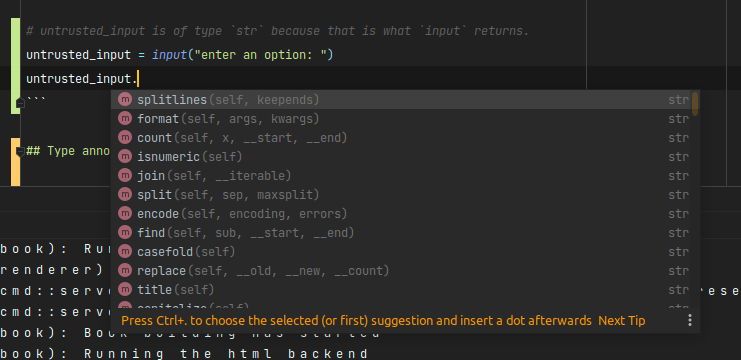
- Types allow your IDE/Editor to provide static-analysis features
# x is of type `int` because it is the result of adding two `int` literals together.
x = 4 + 3
# y is of type `float` because `/` between two ints produces a floating point result.
y = x / 4

# untrusted_input is of type `str` because that is what `input` returns.
untrusted_input = input("enter an option: ")
Type annotation syntax for expressions
Modern python allows for variables to be annotated with types. These annotations serve as development documentation, and are utilized by static analysis tooling to help programmers write code.
The above code example can also, to be more verbose, written as:
x: int = 4 + 3
y: float = x / 4
untrusted_input: str = input("enter an option: ")
name: typedenotes thatnameis an instance oftype
Type annotations are intended for documentation and tooling; the Python interpreter does NOT enforce annotations at runtime.
# NOTE:   The following statement is erroneous,
#         and is intentionally included for demonstrational purposes.
x: float = "I like pizza"
Further reading:
- Typing in the standard library
- Annotating functions later in this presentation